
OpenSensors Blog

Articles

Yodit Stanton

Yodit Stanton

Yodit has designed and built large scale data systems for various sectors and has played a key role in leading development teams to run critical trading and machine learning infrastructure for FTSE500 companies such as, Deutsche Bank, Man Investments, Nomura and Lehman Brothers. With over two decades of experience as a Data and Machine Learning Engineer, Yodit specialises in predictive modeling for real time systems, social network analysis and middleware development.

Getting Ahead of the Curve: A Practical Introduction to Sensors, Occupancy Data and Workplace Optimisation for NHS Trusts

 
Getting Ahead of the Curve: A Practical Introduction to Sensors, Occupancy Data and Workplace Optimisation for NHS Trusts

Across NHS Trusts, senior leaders responsible for estates, facilities and sustainability are making decisions about space that carry long-term financial and operational consequences. As working patterns continue to evolve, it has become harder to rely on traditional indicators alone to understand how workplaces are actually used day to day and gauge the value they provide. 

This blog introduces the thinking behind our Designing the Future NHS Workplace webinar series and offers a practical, non-technical view of how utilisation insight helps Trusts move from assumption to evidence when planning and managing their estates.


Why utilisation matters more than ever

In many NHS workplaces, patterns of activity can be uneven. Areas may feel busy at certain points in the day, while seeing much lower levels of use at other times. Without continuous insight, it can be difficult to distinguish between perceived demand and sustained use. 

Traditional methods - walk-throughs, surveys or historic allocation models - provide useful context, but they rarely capture patterns over time. This creates risk: Trusts may continue to operate and maintain space that no longer reflects actual need or miss opportunities to improve how space supports staff.

To move from assumption to evidence, Trusts need a reliable way to understand how space is used over time, not just at isolated moments. This is where workplace sensors come in, providing continuous, objective insight into utilisation without disrupting staff or operations.


What workplace sensors actually do

Workplace sensors provide that visibility, documenting how shared spaces are used without intruding on staff or operations.

OpenSensors currently uses state of the art occupancy sensors, which records usage anonymously across workplace assets and movement into and out of spaces. They do not identify individuals and do not rely on staff interaction. Instead, they build a clear picture of how frequently spaces are used across days, weeks and months by capturing real-time utilisation data to uncover patterns and trends.

The result is a GDPR-compliant way to understand utilisation, capturing how spaces are used over time without needing staff input or disrupting day-to-day operations.


Turning data into insight

Utilisation data is not aboutmicromanaging space or monitoring staff. Its value lies in what patterns reveal over time when viewed as a trend rather than a snapshot.

Through a single, intuitive dashboard, occupancy data is brought together in one place — combining real-time and historical views to make it easy to see which areas are under- or over-utilised, how usage patterns change across the day or week, and when peak demand occurs. This allows estates and facilities teams to move quickly from raw data to practical understanding, without needing to piece together information from multiple tools or spreadsheets.

Utilisation insight helps answer questions such as:

  • Which areas are consistently used — and which are not
  • Where space is busy only in short peaks
  • How usage varies across buildings, floors or departments
  • Where opportunities exist to repurpose, consolidate or improve space

Alongside live insight, automated reporting can be configured to show trends over time — monthly, quarterly or in line with reporting needs — reducing the need for manual analysis and supporting clearer, more consistent decision-making.


What we mean by workplace optimisation

Workplace optimisation is not about cutting space indiscriminately. It is about ensuring environments support staff effectively while using resources responsibly.

For NHS Trusts, this might involve improving common and shared areas so staff want to use them, redesigning spaces to better support focused work or collaboration, identifying under-used spaces that still incur ongoing cost and aligning space provision with actual demand.


Why this matters financially

Even when spaces are empty, costs continue. Heating, cleaning, maintenance and energy consumption do not stop simply because a room is unused.

According to the 2025 Ubiqisense Insight Report , The Cost of Empty Space in the NHS: Quantifying Waste and Unlocking Efficiency, NHS estates cost £18.8 billion annually to operate. Yet over 2.3 million m² of that space is empty, underused, or not fit for purpose - equating to £1.1–1.5 billion wasted every year. 

By aligning space provision with real demand, Trusts can reduce unnecessary operational spend, avoid investment in under-utilised areas, and build stronger business cases for change. Across large estates, small data-led adjustments can translate into meaningful savings.

A Top 20 US Research Hospital leveraging the OpenSensors Occupancy Solution said the following: ‘We saved £700k in our first year and cut energy-waste by 30%’.


Designing the Future NHS Workplace

In support of teams responsible for space planning across hospitals and medical centres, we are launching the “Designing the Future NHS Workplace” webinar series. The series is designed to demonstrate how utilisation insight can be used in practice to support confident, evidence-based decisions about space — without adding complexity to already stretched teams.

Across the sessions, we will explore how estates, facilities, sustainability and transformation teams can:

  • gain a clearer picture of how space is actually used across different times and locations
  • identify under- and over-utilised areas with greater confidence
  • support staff wellbeing through better-informed workplace design
  • reduce unnecessary estates and energy costs
  • use data to inform long-term estate and sustainability strategies

Each session focuses on a specific theme — wellbeing, efficiency or sustainability — using NHS-relevant examples and practical insights to show how utilisation data can support real-world decision-making.

Are you responsible for estates, facilities, sustainability, transformation or procurement? This webinar series is designed to help you approach workplace decisions with greater clarity and confidence.

Join the first installment of Designing the Future NHS Workplace webinar series,
A Data-Driven Approach to Wellbeing, Efficiency & Sustainability.

Contact us

Get in touch and let us help you navigate and define your workplace strategy.

Whether you need help with workplace analytics, consultation on your strategy or guidance on your workplace plans in a post COVID19 era, we’re here to help.


Read More

Avoiding Gaps in Occupancy Data


How sensor-based solutions ensure you capture true utilisation rates. 

For most, the office is an assumed and constant feature of working life to which little thought is given - its daily operations and provisions are conducted in the background and are only thought about when something goes wrong. This mindset however doesn’t reflect the effort and costs associated with maintaining a fit-for-purpose workplace, or take into consideration the financial impacts of getting it wrong. The need for evidence-based decision making is clear.  

With a single floor of New York office space costing up to $2,000,000 per year in rent alone and increasing numbers of people working from home numerous days a week it is more important than ever that those responsible for space management have the absolute best data available to drive their decision making. 

Without the right data to understand how, when and what spaces are being used and by whom organisations run the risk of not only hampering employee productivity, but also throwing away capital which could be reinvested into the business. 

So, the stakes are high, but how can you ensure that you’re getting the best possible data upon which to structure your planning and decision making? 

There are numerous methods of gathering occupancy and utilisation data across workplace assets and spaces, varying from the old-school manual surveys of the past, through to gathering entry badge data and built-in solutions via other IT tools and finally standalone and specialised sensor-based solutions and analytics platforms. 

In the modern workplace, manual surveys and badge data are no longer fit for purpose. Gathering a snapshot of data two or three times a day or simply how many people have accessed the office at all is clearly not enough information to make informed decisions in the modern, flexible workplace.

Occupancy systems need to be running constantly throughout the day, and be set to capture each instance of utilisation; the more passive and independent from direct employee input a system is the more comprehensive the data gathered will be. 

Monitoring systems which are built-in to existing IT tools, such as webcam and booking based solutions, rely on an employee to confirm and start a session, whether it be at an individual desk or in a meeting room. 

From the get go, the data gathered will never be truly representative of how spaces are being used as any impromptu, unscheduled meeting or usage cannot be captured. Furthermore, relying on 100% uptake from employees’ participation throughout the entire period of study is an impossibility and each instance in which an employee fails to follow the necessary steps impacts the data gathered. 

Sensor-based systems are the only truly passive system which capture data across every asset monitored 24/7 with no ties to employee identity. Furthermore, the data gathered isn’t tied to reservation or booking information, if a meeting scheduled for 1 hour only lasts 20 minutes this will be reflected in the data, rather than it being assumed that the blocked out time was fully used. 

There is also the problem of where built-in solutions are able to be deployed; if a system relies on 3rd party compatible hardware or software - i.e. webcams, calendars, etc - this severely limits the spaces that can be monitored. Footfall throughout floors, bathrooms, breakout spaces and cafeterias is impossible as there is nowhere for the system to be placed, whereas specialised occupancy sensors can be deployed across any asset or space. 

The all-encompassing nature of sensor-based solutions increases the number of decisions teams can base upon the data, looking at cleaning patterns across floors and bathrooms becomes an immediate possibility whilst remaining a blackhole data-wise if using a built-in tool. 

Making decisions on the provision of space, both the amount required and types available, requires understanding fully how existing spaces are utilised and this level of granularity is only provided by standalone, specialised sensor-based systems.


Contact us

Get in touch and let us help you navigate and define your workplace strategy.

Whether you need help with workplace analytics, consultation on your strategy or guidance on your workplace plans in a post COVID19 era, we’re here to help.


Read More

Reclaiming Unused Space


How OpenSensors manages campus-wide utilisation studies 

Our customer has 5000 workspaces spread across multiple buildings, each belonging to departments with independently set work rotations. They knew they were underutilised but lacked the data to verify their knowledge and make informed decisions to reclaim unused space. Now, by working with OpenSensors to gather utilisation data across their office, shared and technical spaces, they are able to reassign spaces based on demand and incorporate saved space into their plans for headcount expansion. Read on to learn more. 


The Problem

A new flexible workplace policy was introduced during the COVID19 restrictions, under which employees were expected to be in the office for 2-3 days a week, but which days these were was up to them and their department heads to define.

Originally this didn’t present any problems; office spaces were assigned on a 1:1 basis and access to other shared and technical spaces was modelled on the back of this with pre-COVID occupancy levels assumed. However, the team responsible for space management and allocation across the campus soon noticed a severe drop in occupancy beyond the expected levels. 

With long-term plans including increasing headcount across departments and the potential creation of a new building to accommodate this growth, the opportunity to and value of optimising space usage in place of expansion was recognised. However, as was the gap in utilisation data required to support these decisions. 


The Solution 

To provide the data required OpenSensors was approached to conduct pilot studies across the spaces in question, showing how workstations and offices are utilised on individual and group bases as well as providing counting data from meeting rooms.

As the pilot progressed and the data provided was verified, a plan to tackle the remaining space was formulated. Department heads were approached by the project leaders and pitched to and the target map grew. 

As the project expanded to include 5000 workstations and the scale of the possible space savings became apparent a new policy was introduced requiring departments to undergo an occupancy study ahead of any changes to space allocation. 

A project plan was developed in which 1000 sensors were to be rotated between departments and locations on a 3-5 month basis, at the end of which their overall requirements were able to be evaluated and its impact on campus-wide utilisation folded into planning. 


Putting the Data to Use

During the first rotation a department’s 120 private offices were studied, with a total square footage of 8,839 - OpenSensors deployed a motion and body-heat sensor at each office’s desk in order to ascertain how many days per week each space was used and for how many hours at a time. 

The team expected some of these offices to be used consistently and regularly, but half or more to be below the schedule set. 

These offices were assigned on a 1:1 basis and employees had committed to a set schedule of 3 days in the office each week, so it would be possible in the early weeks of the study to identify potential ‘low hanging fruit’ - i.e. assets with such low utilisation (<5%) that they can be reclaimed with zero impact. 

A minimum of 3 months data collection is needed when making large or long-lasting decisions, however, enough spaces had consistently close to zero levels of utilisation that the team was quickly able to assist department heads with individual space requests. The team used OpenSensors data to locate sites for transfers and to accommodate headcount growth, 

At the culmination of the study, it was found that 30 of the offices were <5% utilised, and a further 44 were <15% and nearly nobody was following the office schedule. 

The decision was made to take back these 74 underutilised workspaces, which had a combined square footage of 5,616 and in turn convert 2,000 of the reclaimed space into hot desks and locker space. The remaining 46 offices were made shared spaces also, with day rotations established between employees. 

As this process is repeated across departments and buildings and the true extent of underutilised or completely unused space becomes clear the potential for reorganisation and redistribution of space increases dramatically, offering huge savings as headcount growth can be supported without expanding the built environment.


Contact us

Get in touch and let us help you navigate and define your workplace strategy.

Whether you need help with workplace analytics, consultation on your strategy or guidance on your workplace plans in a post COVID19 era, we’re here to help.


Read More

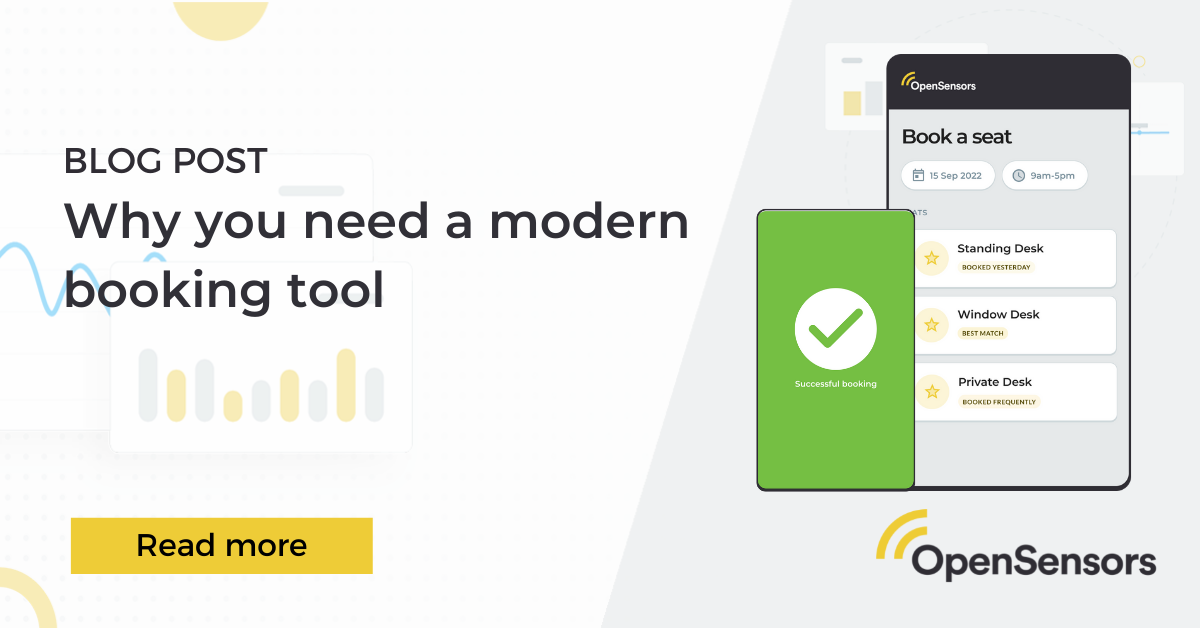
Why you need a modern booking tool

Demands on space and the workplace changed as organisations moved away from traditional working environments, adopting instead hybrid and agile strategies. Now, successful and effective workplaces hinge on flexibility and adaptability - read on to find out how our booking tool promote both.
 

Read More

5 key steps to know when deploying occupancy sensors

Here are 5 key practical steps you need in the early stages of occupancy studies and workplace transformation projects, focussing on physical, data and strategic considerations.
Read More

Search

    Sign up for best practice content